Apartment Cost Sheet Explained in Simple Words

An apartment cost sheet shows the full price a buyer has to pay for a flat. The base price only covers the basic structure and space. In 2026, the total cost will usually go 20–25% higher because of extra charges. These include government taxes like GST and stamp duty, builder fees for better views (PLC), and one-time payments for water, electricity, and maintenance. Checking the cost sheet carefully helps buyers plan their budget and avoid money problems when moving in.
What is Base Price and Agreement Value?
The Base Selling Price (BSP) is the starting price per square foot for the basic structure of the apartment. But this is usually not the final amount. The Agreement Value is higher because it adds mandatory builder charges to the base price. It is used to calculate government taxes like stamp duty and registration fees. Understanding the difference between BSP and Agreement Value helps buyers know the actual cost of the flat before extra fees.
For example, a flat with a BSP of ₹5,000 per sq. ft. and 1,000 sq. ft. area has a basic cost of ₹50 Lakhs. Mandatory charges for amenities and infrastructure add ₹5 Lakhs, making the Agreement Value ₹55 Lakhs. Stamp Duty and Registration Fees are calculated on ₹55 Lakhs, usually adding another 7% to 10% to the total cost.
Main Components of an Apartment Cost Sheet
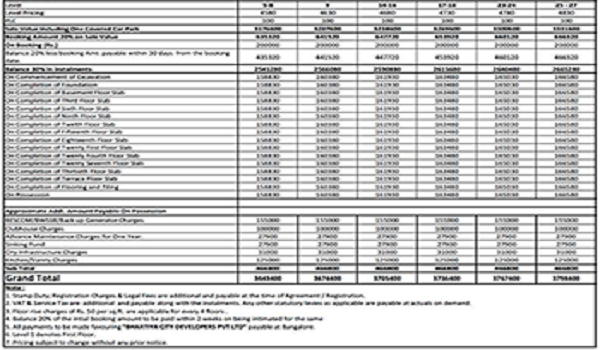
An apartment cost sheet shows how the total price of a flat is made up of different parts. The base price is the starting point, but extra charges for location, floor, and facilities usually increase the final cost. Here is a detailed explanation of the main components:
- Base Price of the Apartment: The Base Selling Price (BSP) covers the basic structure and livable area. It is calculated by multiplying the cost per square foot by the flat’s total area.
- Floor Rise Charges: Flats on higher floors cost more because they get better sunlight, fresh air, and less noise. Builders usually charge an extra ₹20 to ₹80 per sq. ft. for each floor above the base level.
- Preferential Location Charges (PLC): Flats with better views or special features, like corner units, park-facing flats, or Vastu-compliant units, have an extra fee. It will add ₹100 to ₹500 per sq. ft. to the bill.
- Clubhouse and Amenity Charges: These are one-time fees for access to shared facilities such as the gym, swimming pool, and parks. In luxury projects, these fees can range from ₹1 Lakh to ₹5 Lakhs.
- Car Parking Charges: Reserved parking spots in the basement or stilt area are almost never free. In 2026, a single parking slot usually costs between ₹3 Lakhs and ₹6 Lakhs.
Government Charges in a Cost Sheet
In 2026, apartment cost sheets include several government charges that are separate from the builder’s price. These fees usually add 7% to 12% to the total cost and are needed to own the flat legally.
- GST (Goods and Services Tax)
GST is a central tax applied only to flats that are under construction. For affordable homes costing up to ₹45 Lakhs, the GST is 1%. For standard flats, it is 5% without Input Tax Credit. Flats that are ready-to-move and have a Completion Certificate do not have GST.
- Stamp Duty
It is a state tax paid to transfer the property to the buyer’s name legally. It is usually 5% to 8% of the property value. Some states offer a small discount of 1% to 2% if the property is registered in a woman’s name.
- Registration Fee
is paid to record the property officially at the Sub-Registrar’s office. It is usually 1% of the property value, but in some states like Karnataka, it has been revised to 2% in 2026.
- TDS (Tax Deducted at Source)
TDS applies if the flat costs more than ₹50 Lakhs. The buyer must deduct 1% from the payment to the builder and deposit it with the Income Tax Department using the builder’s PAN.
Other Local Charges
Some cities add small extra fees like Metro Cess, Library Cess, or scanning fees. These are usually small, around 10% of the stamp duty or ₹100–₹1,000 for document processing.
Other Additional Charges in a Cost Sheet
These fees are usually paid when taking possession of the flat for legal work and utility connections.
- Legal & Documentation Fees: These are around ₹20,000 to ₹50,000 and are paid to lawyers to check property ownership and prepare the final Sale Deed.
- Maintenance & Corpus Fund: Builders collect 1–2 years of maintenance in advance to cover the daily upkeep of the apartment. The Corpus Fund is a one-time reserve for big future repairs, like painting or fixing elevators.
- Electricity & Water Connection Fees: These are for installing individual meters, transformers, and connecting the flat to the city water supply.
How to Calculate the Final "All-In" Price?
Looking at the base price of a flat is not enough to know the actual cost. The All-In Price is the total amount paid after adding all builder charges, government taxes, and possession fees. In 2026, the final cost is usually 20% to 25% higher than the starting price.
Step 1: Calculate the Agreement Value
The Agreement Value is the amount in the official sale agreement. It includes the base price of the flat plus extra charges from the builder.
- Base Price = Area of the flat × Rate per sq. ft.
- Add Builder Charges = Floor Rise Fee + Preferential Location Charge (PLC) + Car Parking Fee.
The Agreement Value is used to calculate all government taxes.
Step 2: Add Government Taxes
These taxes are paid on top of the Agreement Value:
- GST = 5% for standard flats, 1% for affordable flats
- Stamp Duty & Registration = Around 6% to 10%, depending on the state
- TDS = 1% for flats above ₹50 Lakhs, paid to the IT Department
Step 3: Add Possession and Utility Fees
Many buyers forget the extra costs that need to be paid just before moving in. These are usually listed at the bottom of the cost sheet.
- Maintenance Deposits: 1–2 years of advance maintenance plus a one-time Corpus Fund for future repairs.
- Utility Charges: Fees for electricity meters (BESCOM/TSSPDCL) and water connections.
- Legal Fees: Paid to the builder’s lawyers for preparing the Sale Deed and handling registration paperwork.
The Final Formula is Final All-In Price = (Base Price + Builder Add-ons) + (GST + Stamp Duty) + Possession Charges
Keep an extra 5% to 10% of the property cost for interiors like wardrobes, modular kitchens, and moving expenses. These are not included in the builder’s cost sheet.
Example Calculation of the Total Cost Sheet:
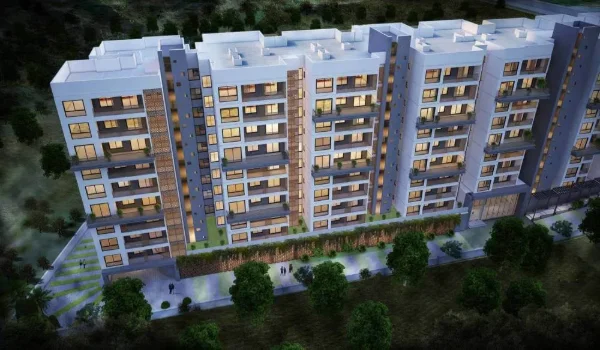
If a Century Tisora flat has a Base Price of ₹80 Lakhs. The total apartment cost is calculated as follows:
- Extra Builder Charges (Parking, PLC, and amenities): ₹10 Lakhs, so Subtotal is ₹90 Lakhs
- Government Taxes (GST 5% + Stamp Duty 7%): ₹10.8 Lakhs
- Possession Costs (Maintenance Corpus, Utilities, Legal): ₹4 Lakhs
The Final "All-In" Price of the flat: ₹1.048 Crore.